




Put an A-style mandolin next to an F-style, and the difference registers before you play a note. One has a clean teardrop body and minimal ornamentation. The other has a curving scroll jutting from one shoulder, two sharp points on the lower bout, and an ornate headstock that looks like it was lifted from a violin family instrument. If you're new to the mandolin and trying to understand what these names actually mean, or if you're shopping for a serious instrument and the choice between styles keeps coming up, this is the question worth answering honestly.
Both shapes are legitimate, well-loved instruments with strong traditions behind them. The difference between them is real but often overstated, and the best choice depends on where you play, what you play, and how much the visual identity of the instrument matters to you. Getting into the specifics of body style is a later-stage question. If you're still building your foundation as a player, the Beginner's Complete Guide to the Mandolin covers the full picture first.
What Makes an A-Style an A-Style (and an F-Style an F-Style)
The A-style body is symmetrical and unadorned. It takes roughly the shape of an almond, with a gentle curve through both bouts and no carving beyond what's needed to build a functional archtop instrument. The aesthetic is workmanlike in the best sense: everything present serves a purpose, nothing is there for show.

The F-style adds three elements. The scroll extends from one side of the upper bout as a carved curl, similar in shape to the scroll on a cello. Two points protrude symmetrically from the lower bout. And the headstock carries additional ornamentation, typically a fleur-de-lis or similar carved detail. All of this first appeared on Gibson mandolins in the early 1900s, when Orville Gibson began applying violin-making principles to mandolin construction.
The F-style's cultural weight comes almost entirely from one instrument: the Gibson F5, designed by Lloyd Loar in 1922. When Bill Monroe began playing an F5 to define the sound of bluegrass in the 1940s, the F-style became permanently identified with that genre. Players who want to play in that tradition, literally and visually, gravitate toward the F-style for that reason as much as any acoustic one.
Underneath all of this, the two shapes share the same essentials. Both are archtop instruments. Both use the same standard scale length of roughly 13 and 7/8 inches. Both are tuned in perfect fifths (G, D, A, E), the same as a violin. The fundamental playing experience is not different. What differs is the body geometry around those strings, and what that geometry actually does acoustically.
Does the Shape Change the Sound?
Here is where opinions diverge, and separating real acoustic difference from marketing is worth the effort.
The scroll does real acoustic work. On an F-style mandolin, the scroll is hollow, and that hollow interior functions as a secondary resonance chamber. Sound generated by the vibrating strings moves through that additional internal volume. Many F-styles also include a small sound port at the base of the scroll, directing that resonance outward into the room. This is a genuine acoustic mechanism. The hollow scroll adds warmth and projection to the instrument's overall output, beyond what the main body cavity produces alone.

That said, the practical impact in most playing situations is more modest than promotional language implies. The F-style's additional projection matters most in ensemble settings, where a mandolin has to compete with guitar, banjo, fiddle, and bass. In that context, every bit of added projection is genuinely useful, and the F-style earns its reputation among bluegrass players for a reason. In solo practice, small-group session playing, or recording where microphone placement handles volume, the difference is real but subtle enough that most listeners would not reliably distinguish it from an A-style in a blind test.
The points and ornate headstock contribute nothing to the acoustic output. They are choices of identity and tradition.
Tremolo is worth mentioning here too. Because the F-style produces more raw projection, the bloom of each tremolo phrase carries further in a room. For players doing a lot of ensemble and stage work, that natural added volume is a real functional advantage, not a marginal one. For players working primarily at home or in the studio, the A-style holds its own entirely.
Price, Prestige, and What You're Actually Paying For
F-style mandolins cost more than A-style mandolins at every tier of the market, and the gap is large enough to shape most purchasing decisions. Some of that reflects acoustic and manufacturing reality. The scroll requires additional material and skilled craftsmanship. But a significant portion of the premium is prestige, and it's worth saying that plainly.

The F-style became the instrument of bluegrass royalty. Bill Monroe played one. So did Ricky Skaggs, Sam Bush, and Chris Thile. The visual identity of the F-style became so tightly linked to the music that purchasing one signals belonging to a tradition as much as it signals an acoustic preference. The market prices that history accordingly.
Top-tier F-style mandolins from Gibson, Collings, and independent luthiers can reach well above ten thousand dollars. A-style instruments from the same makers are consistently less expensive, both because they require less labor to build and because they carry less of the prestige premium. For most players working with a realistic budget, an A-style delivers a genuinely professional result at a lower price, and the acoustic trade-off in anything but a large-ensemble bluegrass context is smaller than the marketing gap suggests.
At the mid-range, the gap is where many buying decisions actually live. A solid A-style from a reputable maker in the $800 to $1,500 range outperforms most F-styles at the same price, because the F-style's scroll adds cost without necessarily improving the core instrument at that tier. Spending more to get an F-style shape at a lower price point often means accepting compromises in construction quality that don't show up until later.
Which Style Suits Which Player
A-style mandolins are the more broadly versatile instrument. Players in folk, old-time, Celtic, classical, and bluegrass all use them regularly. The clean body also sits slightly more naturally against the body when playing seated, which matters for long practice sessions. And the A-style's availability across a wider range of price points makes it the practical starting point for most players.
The F-style carries a strong genre identity with bluegrass and American roots music. If you're playing in bluegrass jams or on a stage with a full band, the F-style's projection is a genuine practical tool, and its visual presence communicates something to the players around you. Showing up to a bluegrass picking circle with an F-style signals a commitment to the tradition that is hard to separate from the purely acoustic argument, because in that world they're the same argument.
One practical consideration that rarely comes up: nut width. Most F-style mandolins use a narrower nut than A-styles. The strings sit slightly closer together at the first fret, which suits players with smaller hands or those coming from a fiddle background where the string spacing is already compact. Players arriving from guitar, where spacing is wider, sometimes find an A-style nut more natural for chord fretting and single-note runs. Neither is better in absolute terms, but it is worth playing both before making an expensive decision.
What Carbon Fiber Does to the Comparison
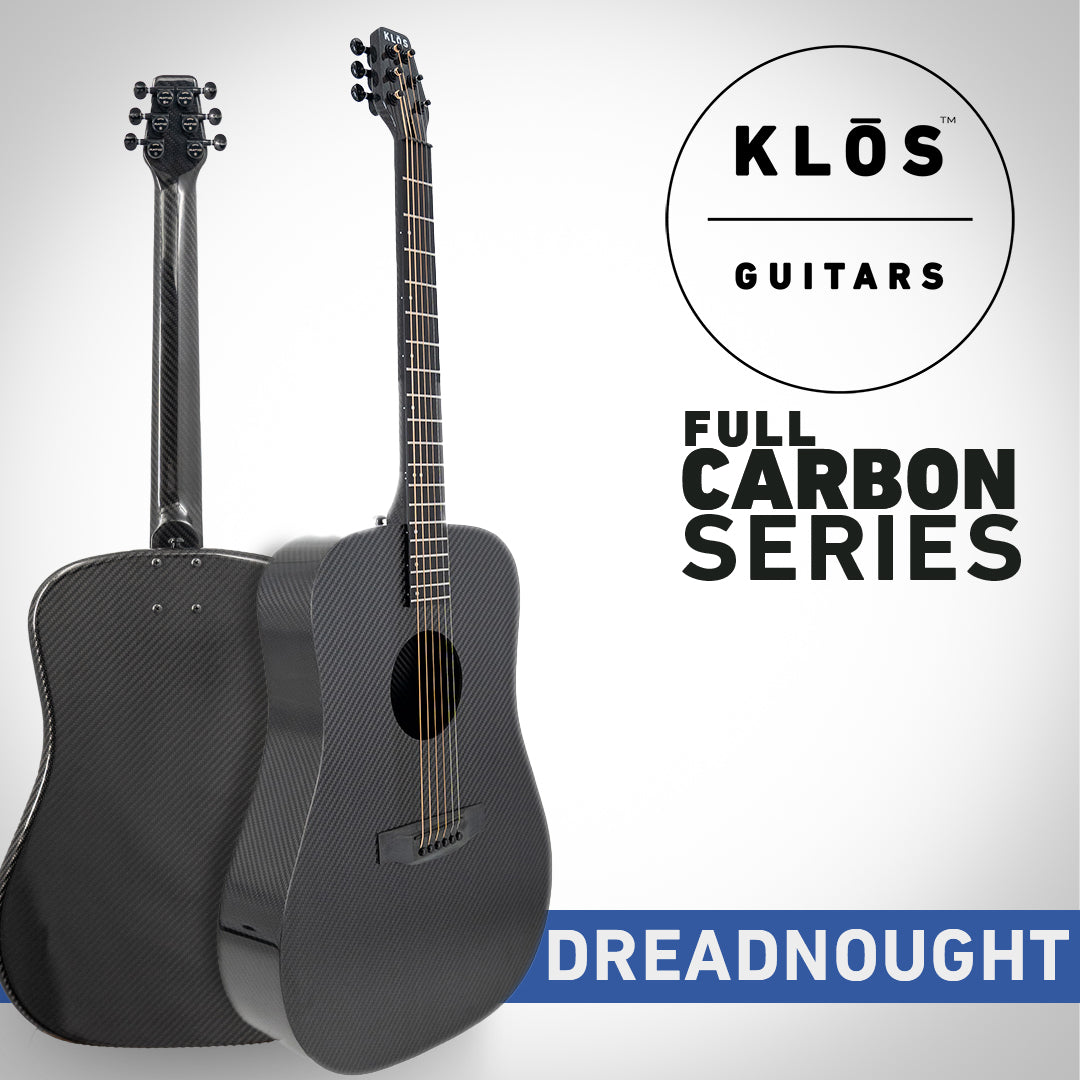
Both body shapes are now available in full carbon fiber, and the material changes the practical calculus for players who take their instrument out into the world.

The KLŌS A-Style Mandolin starts at $2,799 and ships in five to six weeks. It's built from a one-piece carbon fiber body and neck with no truss rod, because carbon fiber doesn't flex with seasonal humidity changes the way wood does. Setup is done on a PLEK machine to precise tolerances, the frets are stainless steel, and the instrument is immune to the humidity cracks, seam separations, and climate-driven neck drift that make owning expensive carved-top mandolins stressful. Carbon fiber also produces a brighter, more sustain-rich tone than a comparable wood instrument, with strong projection in live settings.
The KLŌS F-Style Mandolin applies the same construction approach to the F-style's more complex geometry. The scroll is fully hollow, the sound port is functional, and KLŌS characterizes the result as their benchmark performance instrument: loud enough to cut through horns and banjos in a full bluegrass ensemble. It starts at $3,799 and carries a lead time of four or more months, reflecting the additional difficulty of producing the scroll and points geometry in carbon fiber. The F-Style also uses a narrower nut (1 1/8 inches versus 1 3/16 inches on the A-Style), a Soft V and C blend neck profile, and machine heads available in satin chrome or real gold plating.
For anyone considering carbon fiber specifically, the practical choice between the two tracks the traditional one cleanly. The A-style is the versatile working instrument. The F-style is built for stage performance and ensemble projection. What carbon fiber adds to both is the ability to own either without the maintenance burden: no humidifier, no seasonal truss rod work, no cracked tops in a dry winter. Both come with a lifetime warranty and the same PLEK-precision setup from the factory.
The mandolin community has debated A versus F for over a hundred years. Carbon fiber doesn't settle that debate. It just makes both sides of it considerably easier to live with.


Leave a comment